The short answer
First establish which visits come from your team and which connections a rule actually covers. A GA4 filter in testing and an active exclusion are different states. The objective is a defensible measurement scope, not a more attractive report.
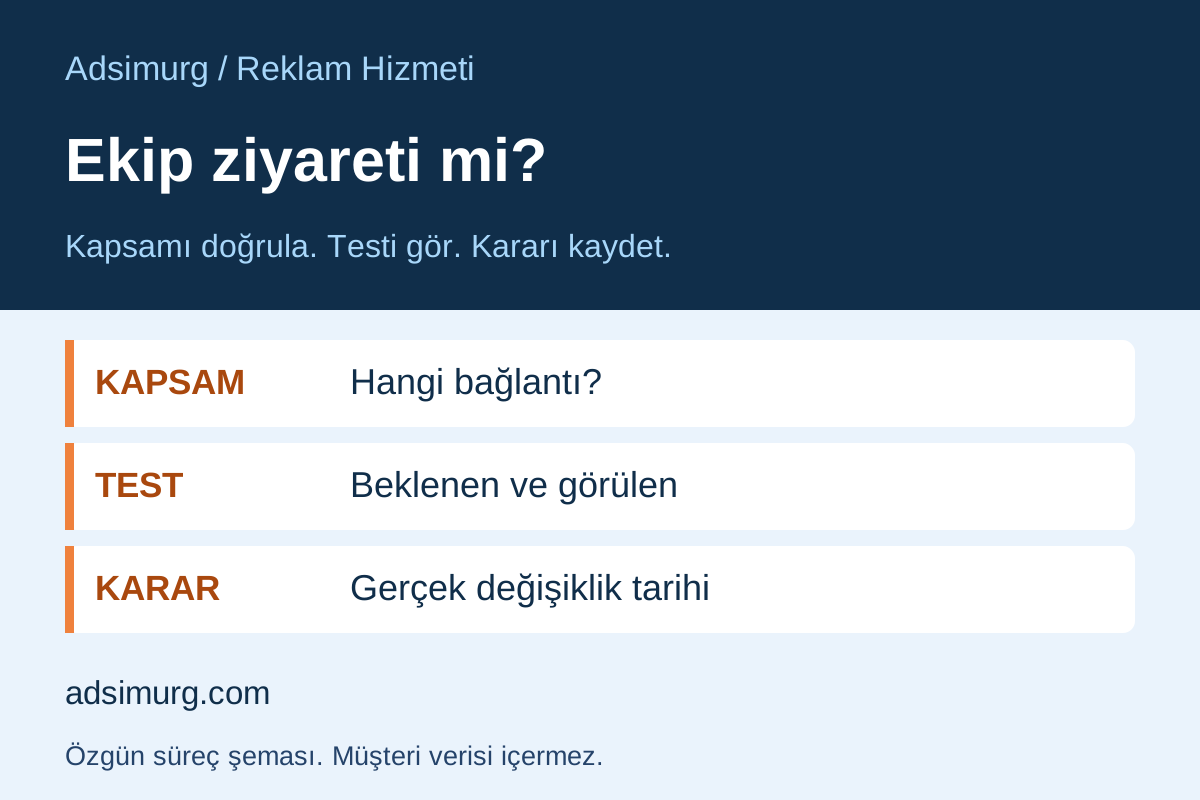
| Kontrol / Check | Kayıt / Record | Ayrım / Distinction |
|---|---|---|
| Question | Affected report and period | All traffic is internal |
| Test | Expected and observed class | A saved setting |
| Control | Visit from another connection | Missing data proves success |
| Decision | Scope and actual date | A higher rate means sales |
Write the reporting question first
Your team may have opened a new campaign page repeatedly. Do not attribute every additional visit to that activity. Record the report, day and event that prompted the concern. In a paid marketing review, clicks, enquiries and verified sales remain separate measures. Separating internal visits does not automatically reconcile those stages. A missing sales record still needs its own investigation rather than being treated as a problem a traffic filter can solve.
Keep the technical distinction clear
Google’s official guide describes identifying internal web traffic through IP rules and a traffic_type value. Testing allows matches to be assessed; an Active exclusion permanently affects incoming data. Excluded data cannot later be recovered in Analytics or BigQuery. Examine test evidence before enabling a live exclusion. This article provides a review method. It does not establish that a filter exists in your property or that any settings have been changed.
Verify scope with the authorised owner
Office, home and mobile connections may differ. One observed address is not necessarily a permanent definition of the entire team. Ask the responsible technical owner to establish which connection is covered. An overly broad rule may affect actual visitors. Keep scope, owner and verification date in the review record without placing sensitive connection details in a public report. Do not add an unidentified network based on a guess or a familiar-looking name.
Prepare two controlled test visits
In a fictional exercise, one team member opens a test page from a verified office connection. An authorised control test uses a separate connection assessed as outside the team. Record time, page and expected classification for both. This is a proposed validation method, not customer evidence or a performance result. Use accessible evidence without creating real orders or changing existing consent choices. Make sure everyone involved understands that the visits are tests.
Compare expected and observed behaviour
In the analytics review, record whether the test visit was observed, whether the expected rule matched and whether the control visit was affected. An absent visit is not automatically proof of successful filtering. Collection and reporting coverage need separate assessment. Keep unresolved evidence marked as unknown. A saved configuration screen or a correctly spelled rule name does not prove that real customer traffic remains unaffected.
Date the decision and preserve comparability
If the authorised team approves implementation, retain the scope, owner and actual change time. Earlier and later periods may then cover different data. Do not interpret fewer sessions automatically as advertising loss, or a higher conversion rate as evidence of more sales. Explain the coverage difference in the report and assess verified enquiry and sales records separately. Avoid casually changing existing measurement or privacy choices during the investigation.
A starting checklist
- Define the reporting question.
- Verify rule coverage.
- Separate team and control tests.
- Do not treat absence as proof.
- Assess evidence before exclusion.
- Document period coverage differences.
The Adsimurg approach
Adsimurg connects paid marketing reporting with measurement scope and actual business outcomes. A free Advertising and SEO audit can examine the decision process for internal traffic. Filtering does not guarantee sales or complete data.
Explore the relevant service scopes to put this plan into practice: Paid marketing, Growth strategy & analytics.