The short answer
Do not reject an out-of-town real estate enquiry solely because of the person’s current location. The desired area, property type and business service scope matter. Review Google Ads location options against that need, without presenting inferred location as proof of moving intent or a completed transaction.
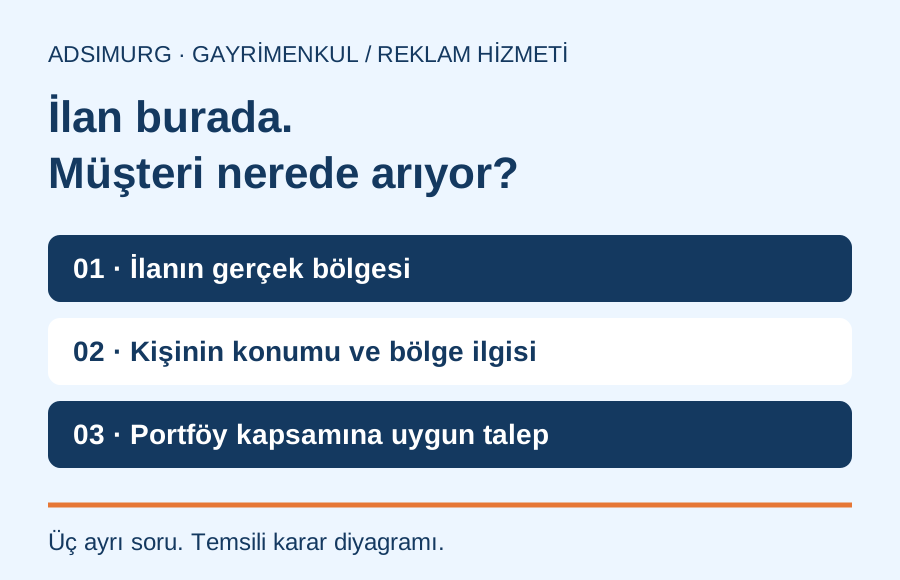
| Question | Decision use | Does not prove |
|---|---|---|
| Where is the property? | Actual inventory and service area | The customer’s current city |
| Where is the person? | Access and consultation arrangements | Their desired property area |
| Which area do they want? | Fit with the portfolio | A purchase or rental decision |
Separate the property location from service boundaries
An agency’s office neighbourhood may not describe its whole portfolio. Confirm the actual service areas and authorised listing scope first. Sale and rental enquiries, property types and viewing arrangements may need separate workflows. The advertising service brief should record the property location, current availability and receiving team. Do not promise services in unsupported areas just to increase reach.
Understand presence and location interest
Google’s location options can distinguish people likely to be in, or regularly in, a target area from people showing interest in that area. Location estimation uses several signals and is not exact. This distinction does not automatically make an out-of-town enquiry good or bad. Read the setting currently available in the business’s campaign type rather than assuming all advertising formats provide identical options.
Make the property page explicit about area and scope
The listing page and conversion route should explain which property the visitor is evaluating in its opening section. Verified neighbourhood information, property type, current listing status and contact purpose should agree. When a property is withdrawn, check that an old advertisement is not still directing people to an unavailable offer. Clearly label any suggested alternative as a different listing. Do not present illustrative images as real portfolio photography.
Illustrative example: a relocation enquiry and an unrelated request
Imagine a person in Istanbul looking for a rental home in a particular part of Izmir. If the agency has suitable inventory there, being out of town does not make the enquiry irrelevant. Someone seeking commercial premises in an unsupported area raises a different scope issue. Assess these cases through the requested area and property type rather than merging them by current city. These are illustrative scenarios, not customer information or campaign results.
Keep initial qualification questions proportionate
Desired area, sale or rental purpose, property type and preferred consultation format may provide a useful starting point. Request only the information needed to assess the service, without collecting unnecessary private details. In CRM, distinguish available matching inventory, alternative inventory needed, out of scope and viewing arranged. A submitted form does not establish a confirmed purchasing decision.
Review location decisions with enquiry outcomes
Report the campaign setting, property area and verified enquiry scope separately. If the source cannot be linked reliably, do not assign an enquiry to a specific campaign with certainty. Distinguish planned viewings, completed conversations and business outcomes. Excluding cities by form cost alone can be misleading in a low-volume period. The listing-to-viewing workflow guide complements this review. Define the question and responsible owner before changing settings.
A starting checklist
- Confirm the actual service area and listing scope.
- Separate sale and rental purpose.
- Read the existing location option accurately.
- Do not treat inferred location as certain.
- Keep property pages current and explicit.
- Request only necessary enquiry information.
- Separate viewing arrangements from business outcomes.
The Adsimurg approach
Adsimurg connects real estate advertising with the portfolio’s actual scope, listing pages and viewing follow-up. Include a sample listing and service areas in a free Advertising and SEO audit request to review location messaging, the enquiry route and qualification criteria together.
Explore the relevant service scopes to put this plan into practice: Paid marketing, Landing pages & CRO, CRM & sales operations.