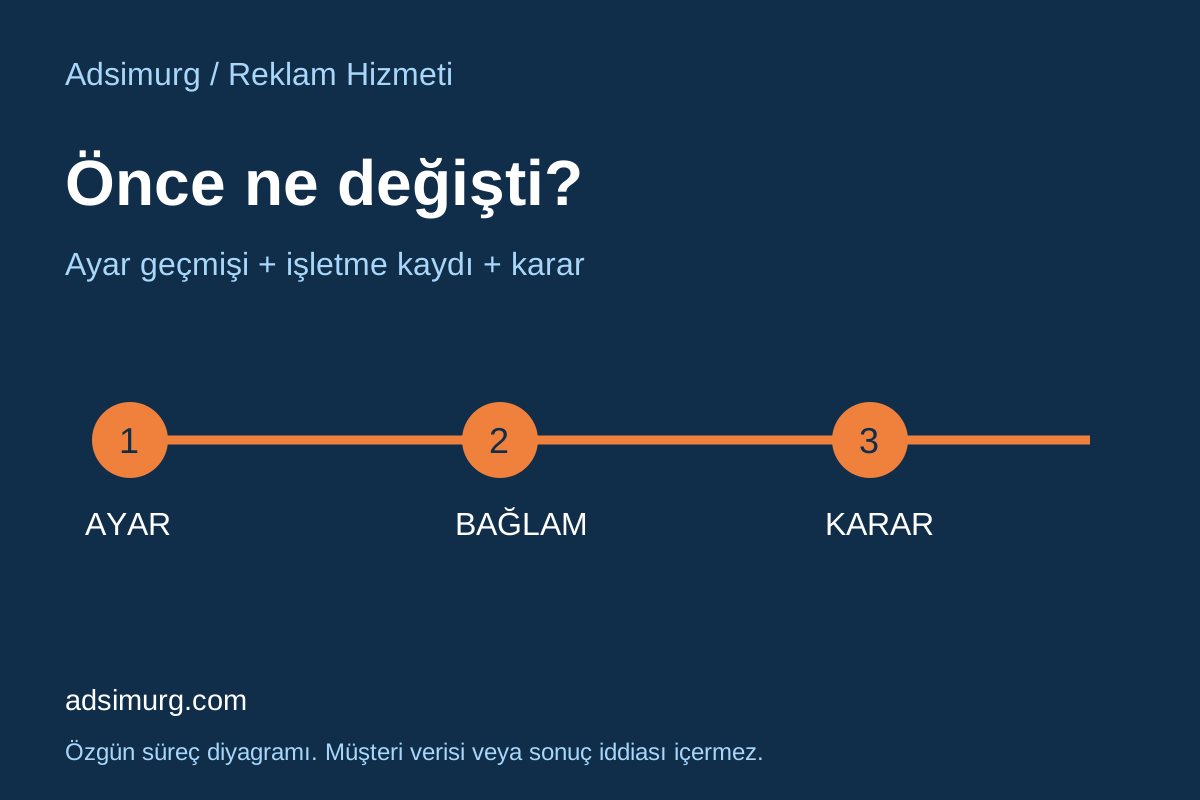
The short answer
Before interpreting a performance difference, check which settings changed within the same scope and date range. Change history helps reconstruct the account timeline. It does not prove that a particular adjustment caused sales to rise or fall.
| Kontrol / Check | Kayıt / Record | Ayrım / Distinction |
|---|---|---|
| Scope | Campaign, dates, measure | Unequal comparison periods |
| Account | Actual setting entry | Proof of causation |
| Business | Stock, site, team record | An assumed event |
| Decision | Owner and review date | Guaranteed results |
Fix the scope of the comparison first
Write down the campaign, date range and outcome under review. Confirm the account time zone and the report’s data coverage. Spend, submitted forms and verified sales are different measures. In a paid marketing review, do not compare a previous period’s completed sales directly with today’s enquiries that have not yet been assessed. Retain the time the report was captured so colleagues can understand why a later view may contain different information.
Use history to narrow the investigation
Google Ads’ official documentation says change history can show account changes from the last two years. Filters such as campaign, user and change type can focus the review. Read relevant budget, bidding and conversion-setting entries. Record the actual rows available to you rather than guessing when a setting changed because its current value looks different. The recorded user or tool can help direct a question to the responsible team.
Keep a separate record of changes outside the account
An advertising account is not a complete operational diary. Stock availability, prices, a broken website form or the sales team’s response time may also have changed. Verify those events with the relevant owner and date them in a business log. In analytics planning, consider advertising settings alongside the customer journey. Mark a missing operational record as unknown instead of presenting an assumption as an established event.
Do not choose one cause when three things changed together
Imagine a business changing its budget, replacing a landing page and reducing form fields on the same morning. A subsequent increase in enquiries does not isolate the budget’s effect. Day-of-week demand or an announcement outside the campaign might also matter. This is a fictional example, not a client result. The evidence shows concurrent changes. It does not justify inventing a contribution percentage or a quantified return for any individual adjustment.
Connect the decision record to the next controlled step
For each material change, record the observed problem, expected behaviour, affected scope, authorised owner and review date. Specify which business record will be used to assess the measured outcome. Reducing unnecessary simultaneous changes in a later test can make interpretation easier. A decision log still does not replace a controlled experiment. Do not increase spending solely because a graph moves upward; retain the business’s authorised limits and actual capacity.
Do not assume every change can be undone
Google describes undoing certain changes when that option is possible. Do not assume every setting can automatically return to its earlier state. An authorised team should inspect the current configuration, affected campaigns and likely consequences before acting. Finding a historical entry is not the same as completing a correction. Close the review by recording the action taken, or the reason for leaving the setup unchanged, separately from the newly observed behaviour.
A starting checklist
- Define the outcome being compared.
- Check time zone and data coverage.
- Locate actual history entries.
- Verify operational events separately.
- Separate concurrency from causation.
- Record the authorised next step.
The Adsimurg approach
Adsimurg assesses campaign decisions alongside measurement and business records. A free Advertising and SEO audit can structure the investigation of a performance difference. Account history alone does not establish a sales result or guarantee improvement.
Explore the relevant service scopes to put this plan into practice: Paid marketing, Growth strategy & analytics.