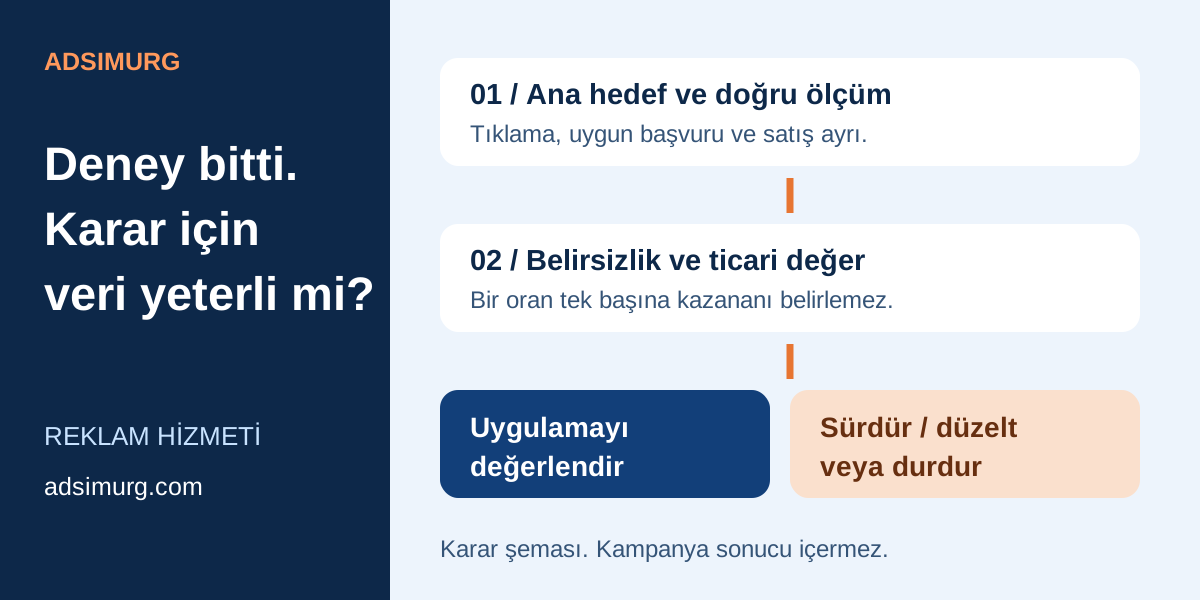
The short answer
Do not declare an experiment a winner solely because clicks increased or costs fell. Assess the predefined business metric, measurement reliability and uncertainty together. If the evidence cannot support a decision, the result can remain inconclusive without automatically being a failure.
| Observation | Decision | Verify first |
|---|---|---|
| Supported improvement in the main objective | Consider applying | Lead quality and operational capacity |
| Unclear difference, reliable measurement | Continue within agreed limits | Remaining time and spending limit |
| Broken event or form tracking | Repair measurement | Whether results remain comparable |
| Business loss limit exceeded | Consider stopping | The predefined safeguard |
Write a decision question and narrow the change
Replace “Which campaign is better?” with a question that can be answered. For example, examine whether a message emphasising a business quotation contributes to enquiries the sales team considers suitable. Changing advertising, targeting, forms and offers together makes the reason for any difference harder to explain. The creative testing guide helps choose ideas; this guide concerns the conditions for applying a result. Include the hypothesis, changed element and preserved conditions in your Advertising Services brief.
Connect the platform metric with the business objective
Google Ads experiment reporting provides comparison metrics, performance differences and confidence intervals where available. Conversion metrics require conversion tracking; inspect the actual event definition. Form submissions, suitable enquiries and sales are distinct stages. When suitable enquiries are the primary objective, the sales team must use the same qualification rules for both groups. If that information is not sent to the platform, state the limitation rather than describing every platform conversion as a qualified prospect.
Avoid treating a single rate as the complete result
A handful of events can change a rate substantially when enquiry volume is low. Read the available confidence interval and significance information alongside the selected metric and reporting dates. When an interval allows both a positive and negative difference, a strong directional conclusion is harder to justify. Statistical significance alone does not establish commercial value; a small difference may not cover the work needed to implement it. Do not invent a universal duration or conversion-count requirement.
Set the review date and loss limit in advance
Record the review date, permitted spending and reasons for an emergency stop before starting. A broken checkout, failed form or incorrect advertised price differs from ordinary performance variation. Address measurement and customer experience when such faults appear. If sales qualification takes time, specify which recent enquiries are still incomplete. More data is not a reason to automatically raise spending. Decide within the existing limit and the business’s operating capacity.
Illustrative example: inexpensive forms and suitable enquiries
Imagine a fictional B2B company testing two messages that lead to the same service page. One emphasises general information, while the other addresses a specific business need. More forms from the first message may include enquiries outside the service scope. Keep source, need, qualification stage and outcome separate in CRM records. A repeat form from one person is not automatically a new opportunity. This is a planning example, not actual client data or a measured experiment result.
Record the application decision and its follow-up
Include the date, scope, primary metric, uncertainty, lead quality and reasoning in the decision note. After applying a change, verify which settings were carried over and schedule the next review. Google describes automatic application for some experiment types; check the actual account setting instead of assuming that application requires a manual action. A result during the experiment does not guarantee future performance. Your marketing report should distinguish the decision from subsequent observations.
A starting checklist
- Define the hypothesis and one primary metric.
- Verify the conversion event and enquiry qualification.
- Read reporting dates and uncertainty together.
- Set time, spending and emergency-stop conditions.
- Check the actual automatic-application setting.
- Record the reason and next review date.
The Adsimurg approach
Adsimurg connects campaign management with experiment design, conversion tracking and business evaluation. Bring your current experiment question to a free Advertising and SEO audit so we can identify the evidence needed for a decision and the remaining measurement gaps.
Explore the relevant service scopes to put this plan into practice: Paid marketing, Growth strategy & analytics, CRM & sales operations.