The short answer
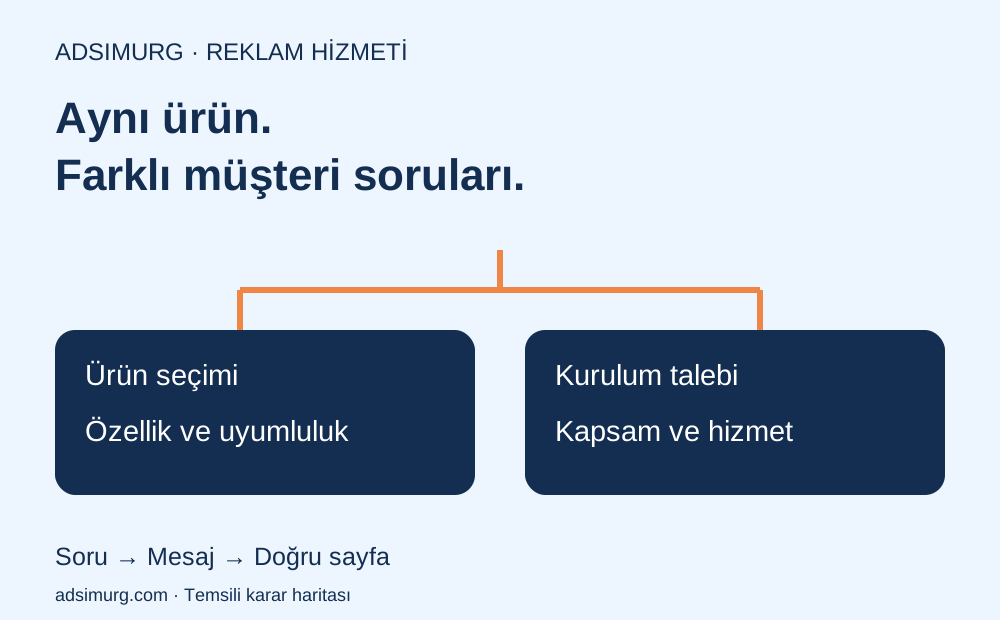
Plan ad groups around the question a customer needs answered, the offer you can actually provide and the page that explains it. Separate needs that require different answers. Avoid creating extra groups solely for minor wording variations of the same need.
| Need | Message focus | Required destination answer |
|---|---|---|
| Choose equipment | Supported use conditions | Features and compatibility |
| Arrange installation | Actual service scope | Coverage and enquiry process |
| Get product support | Available support type | Scope and request route |
Start with a decision map, not a product list
A product catalogue is a useful starting point, but it does not describe every buying question. One person may be learning what a product does while another is checking compatibility with an existing system. Put actual sales questions beside the pages you already have. In an advertising service brief, record the question, the information you can substantiate and a suitable destination. Leave unknown demand and sales figures unknown.
Apply the official principle to your offer
Google’s official guide recommends grouping related keywords by products, services or categories. That principle does not prescribe the right level of detail for every business. Use the need your page answers and the scope you can deliver to guide the decision. Mixing support enquiries with new purchases can create a mismatch where the advertising message and destination do not answer the same question.
Illustrative example: equipment sales and installation
Imagine a business that sells network equipment and offers on-site installation. A product researcher needs connections and supported use conditions. An installation buyer needs service coverage, scope and an enquiry process. Match these needs with real relevant pages instead of sending everyone to a general homepage. This example is a planning exercise, not performance evidence. Do not advertise installation if it is not actually available.
Test the distinction against your content
Can you write a meaningfully different and accurate message for the proposed group? Can the destination provide a different useful answer? If both answers are no, the benefit of separation is unclear and may merely add reporting rows. Keeping genuinely different services together can also weaken relevance. Plan landing page improvements with the same need map, rather than treating the campaign structure and website as separate projects.
Read the full promise before publishing
Read the search phrase, headline, description and first answer on the destination in sequence. Correct any point where the promise changes. In creative production, relevance should come from appropriate evidence and a clear offer, not just different colours. Test that the link opens the intended page on a phone. Do not assume that every ad group needs its own campaign.
Judge outcomes rather than the number of groups
Review actual search context, unsuitable expectations and unanswered questions. Without a definition of a qualified enquiry, clicks and forms alone cannot establish success. The search terms guide supports this review. Record when the structure changed. If the message, destination and offer also changed, avoid attributing the outcome to a single grouping decision.
A starting checklist
- Does each group have a clear customer question?
- Is the advertised offer available?
- Does the destination answer the question?
- Are there needless copies of the same intent?
- Is the mobile destination correct?
- Are qualification and the change date recorded?
The Adsimurg approach
Adsimurg reviews campaign structure together with advertising messages and customer decision pages. A free Advertising and SEO audit can map one product or service group and identify practical improvement priorities.
Explore the relevant service scopes to put this plan into practice: Paid marketing, Landing pages & CRO, Visual design & video production.