The short answer
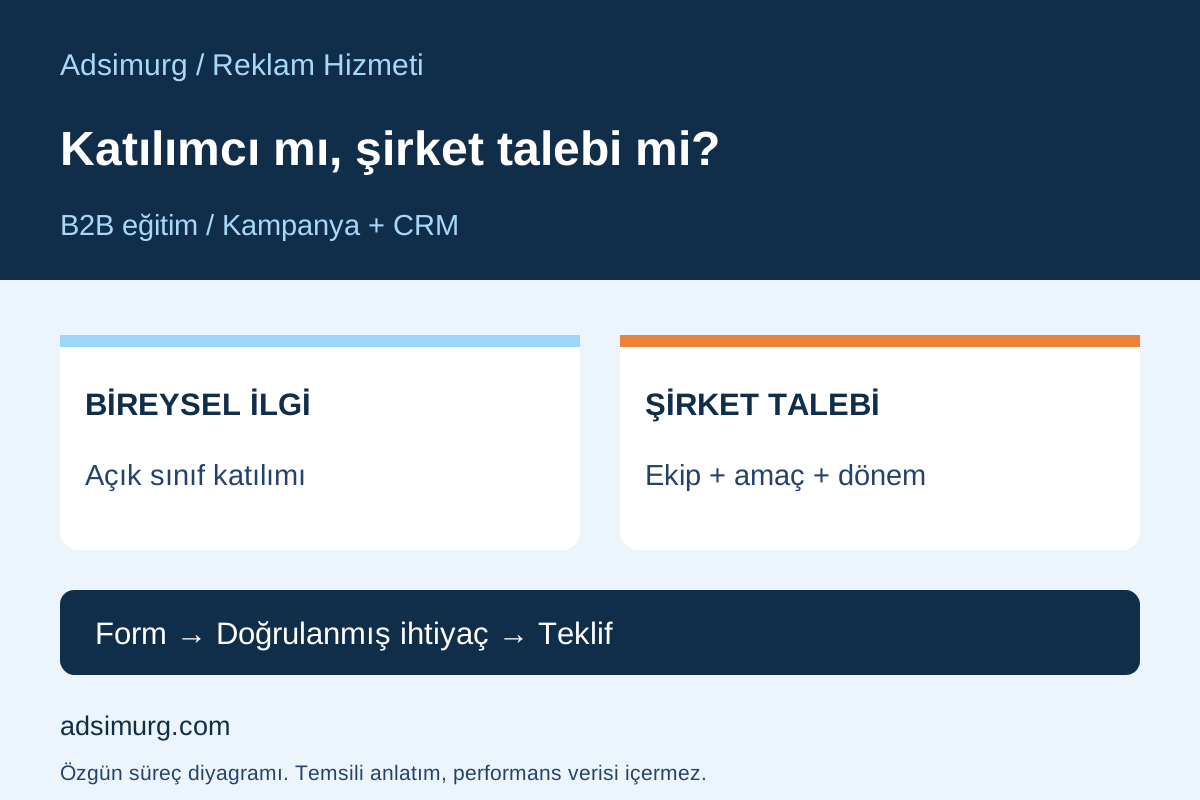
State whether the programme is for individual participants or a company team. For tailored training, ask for information that defines the proposal, such as objectives, approximate team size and timing. A form submission does not establish purchasing authority or a sale.
| Check | Evidence | Decision boundary |
|---|---|---|
| Offer | Individual or tailored team programme | The same title does not mean the same need |
| Form | Objective, team range and period | Avoid unnecessary employee data |
| CRM | Verified enquiry type | Not every enquirer has buying authority |
| Report | Conversation, proposal and acceptance | Submissions are not sales |
Define the training format before writing the ad
One course title can serve two buying journeys. An individual considers joining an open course, while a company explores team needs, adaptation and scheduling. Consider a fictional presentation-skills programme: someone researching personal development and a business seeking training for its sales team need different proposals. State the intended format clearly. Do not invent certification, accreditation or formal qualifications.
Use creative tests to clarify different expectations
One creative might explain the learning focus, while another describes the process for adapting a programme to a team. Record which audience and offer each version addresses. A free content download should not count as the same outcome as a paid training enquiry. In the advertising plan, an actual programme request can be the initial measurable step. Assess customer acquisition through subsequent conversations and proposals verified by the sales team.
Ask only for information needed to scope an initial response
Objectives, an approximate participant range, remote or in-person preference and the intended period can help scope a tailored programme. Decide which fields are necessary before making all of them mandatory. Avoid requesting employee lists or staff assessments at first contact. W3C’s forms guidance recommends labels that describe a control’s purpose and are associated with that control. In the website and conversion review, test field names and selections on mobile.
Do not automatically label every enquirer a decision maker
An employee may be researching options without authority to commit the company. Clarify the team need and evaluation process politely in the first response. Distinguish individual participation, corporate scoping requests and content interest in CRM. If the same person submits again, inspect the existing record before counting another opportunity. If the CRM integration is not operating, do not report automatic matching as an implemented feature.
Connect reporting to scheduling and proposal capacity
Track submissions, verified organisational needs, proposals and accepted work as separate stages. Agree how the team will respond when trainer availability or the delivery calendar is full. A cheaper creative could attract more individual questions, but treat that as a hypothesis until observed. For a longer sales process, a pending response is not yet a lost opportunity. Record the next review date and maintain the distinction between unknown and confirmed outcomes.
A starting checklist
- Specify the training format in the ad.
- Match the destination to the offer.
- Separate required and optional fields.
- Test labels on mobile.
- Verify enquiry type through conversation.
- Date proposal and capacity updates.
The Adsimurg approach
Adsimurg connects advertising messages, enquiry journeys and CRM stages for B2B training services. A free Advertising and SEO audit can identify where individual interest and corporate enquiries become mixed. Enquiry volume and sales outcomes are not guaranteed.
Explore the relevant service scopes to put this plan into practice: Paid marketing, Landing pages & CRO, Marketing automation.