The short answer
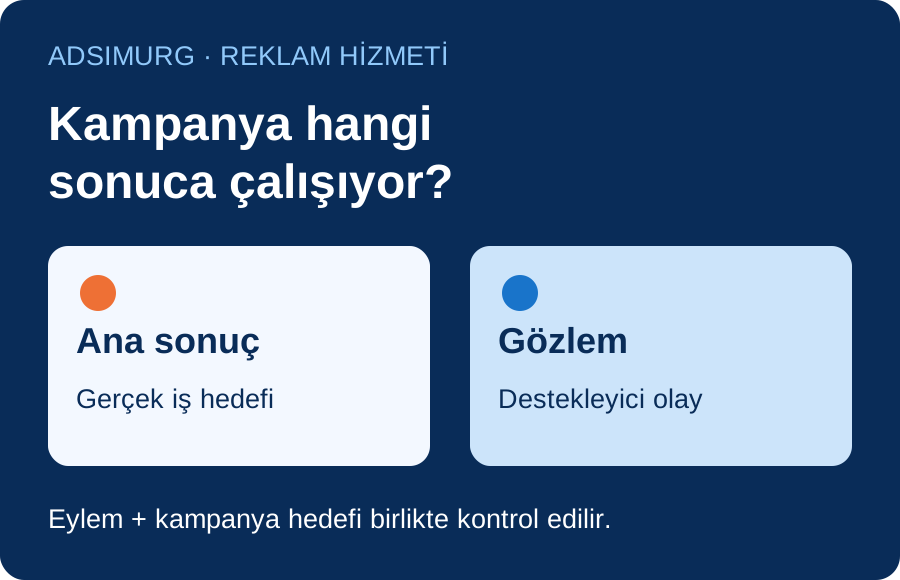
A primary action can guide bidding when its goal is used by the campaign. A secondary action normally supports observation, but inclusion in a custom goal can make it biddable too. Review the event definition and the campaign’s actual goal selection together rather than relying on the primary or secondary label alone.
| Observed action | What it indicates | What to verify first |
|---|---|---|
| Click on a phone button | A signal of contact intent | Whether a conversation took place |
| Successfully submitted form | An enquiry record | Suitability and duplicate records |
| Sales-qualified enquiry | Defined suitability criteria | Consistent rules and actual data transfer |
| Completed order | A purchase record | Cancellation, refund and measurement scope |
Write the business decision first
“More conversions” is insufficient as a standalone objective. Does the business want more enquiries, requests for a specific service or completed orders? A guide download and a quotation request on the same page have different commercial meanings. Put the objective, event definition and person responsible for reviewing the outcome in the Advertising Services brief. An action useful for observation does not necessarily belong among the outcomes that guide the campaign.
Read the action setting alongside the campaign goal
Google Ads describes primary actions as reported in the Conversions column and used for bidding when their standard goal is used by the campaign. Secondary actions normally appear in All conversions for observation. Actions included in a custom goal can be used for bidding regardless of that distinction. An action-list screenshot therefore does not constitute a complete review. Open the relevant campaign’s selected goals as well. This guide describes an inspection method, not a claim that any live account settings have been changed.
Do not label form volume as customer suitability
Opening a success page, recording a valid form and obtaining a suitable business enquiry can represent different events. First use the measurement test guide to confirm that the event is accurate and counted once. Then define how the sales team decides whether the request fits the service. If qualification is not transferred to the advertising platform, do not assume the campaign report knows it. Keep “form enquiry” as the report label and show subsequent CRM qualification separately.
Illustrative example: a guide download and a quotation request
Imagine a B2B page offering a technical guide and a quotation form. Downloading the guide may indicate research, while completing the quotation form represents another stage. If the current objective is quotation discussions, examine the form definition and actual sales process first. Keeping downloads for observation is an option to assess, not a universal account setting. Low enquiry volume does not justify equating downloads with sales. This fictional example demonstrates a decision method rather than actual performance or a guaranteed result.
Record the state before and after a change
Document the current goals, actions, affected campaigns and review date. Repairing measurement and changing the main business objective are different decisions. Explain the affected scope and limits of comparisons with earlier reports. Changes to goals, budgets, messages and pages at the same time make subsequent differences difficult to attribute to one cause. Preserve consent, data boundaries and existing privacy settings. Do not copy enquiry text or personal contact information into measurement fields.
Make the report answer two questions
Ask “Which measured action guides this campaign?” and “How is the business suitability of that action evaluated?” Maintain a short inventory showing the action name, actual trigger, campaign goal, reporting column and latest test date. Mark an unknown transfer status as unknown. Before setting up a campaign experiment, stabilise the measurement definition. A better configuration does not guarantee a particular sales result or future acquisition cost.
A starting checklist
- Define the main business objective in one sentence.
- Test the actual trigger for each event.
- Inspect the standard or custom goals used by the campaign.
- Avoid reporting observation events as sales.
- Record the change date, scope and reasoning.
- Compare enquiry quality using actual accessible records.
The Adsimurg approach
Adsimurg connects conversion tracking with campaign management and sales evaluation. A free Advertising and SEO audit can start with your current goal inventory to clarify which actions support decisions and which evidence is still missing.
Explore the relevant service scopes to put this plan into practice: Paid marketing, Growth strategy & analytics, CRM & sales operations.