The short answer
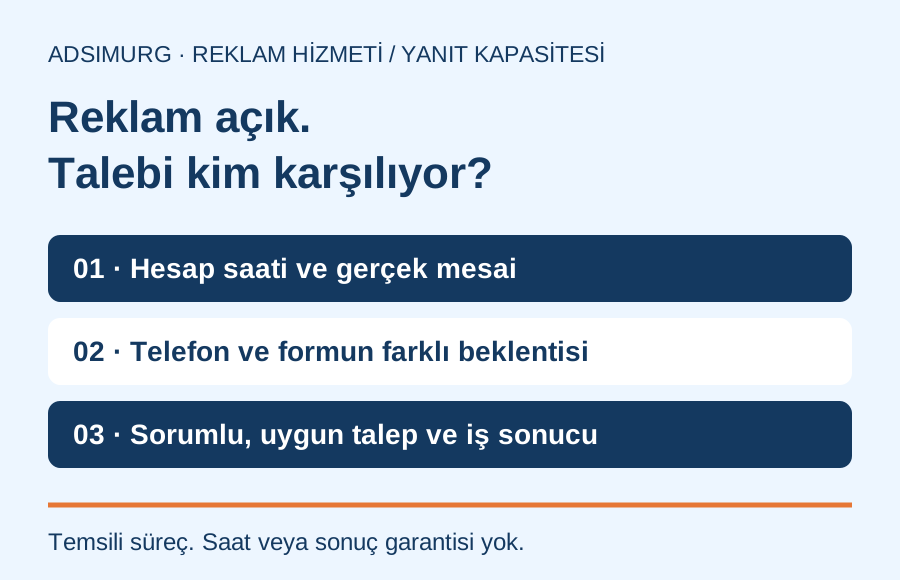
Build the schedule around how the business handles enquiries. A campaign promising a live telephone response may need a different plan from a form reviewed the next morning. Confirm the account time zone, responsible team member and response expectation first. Assess timing through qualified conversations and verified business outcomes.
| Route | First check | Decision record |
|---|---|---|
| Telephone | Actual ability to answer at that time | Connected conversation and qualified enquiry |
| Form | Submission acceptance and later follow-up | Time, owner and stage |
| Online order | Product, stock and checkout | Verified order and fulfilment |
Define the response the campaign promises
An after-hours enquiry is not automatically lost. A form can be reviewed the following morning, while someone expecting immediate telephone assistance faces a different experience. In an advertising service plan, the call to action, contact route and team operating hours should communicate one consistent expectation. Do not promise a response time the business has not approved. If the objective is a sale, a telephone click is not the final outcome.
Check the time zone before deciding hours
Google Ads schedules use the account time zone. Selected periods determine when ads are eligible to appear; they do not guarantee continuous delivery. These two technical points are described in Google’s linked documentation. Write down the conversion between customer local time and account time. Read the existing setting accurately rather than changing it as part of a routine review. Consider time differences separately for campaigns serving another country.
Put the capacity table beside the schedule
Use a weekly operating table with day, enquiry channel, owner and actual team capacity. Leave, meetings and busy service periods can create a different response capacity from published opening hours. In CRM and sales processes, separate receipt from the first genuine review. An automatic acknowledgment is not a team response. Collecting personal telephone records or audio is not a prerequisite for this initial plan.
Illustrative example: separate calls from quotation forms
Imagine a technical service business taking calls during staffed hours and quotation forms in the evening. Review the telephone campaign against periods when someone can actually respond. The form page explains when requests will be reviewed. Avoid making two conflicting promises to one visitor. This is an illustrative process, not campaign evidence or a universal recommendation of particular hours. Adapt it to the business’s verified staffing and service scope.
Change the schedule to answer one clear question
Write the issue first: unanswered calls, delayed review or unsuitable enquiries? Changing hours, targeting and creative together makes causal interpretation harder. Compare periods with notes on day type, season, spending and record coverage. A few enquiries do not establish a winning time slot. The telephone measurement guide explains why clicks and conversations are different stages.
Test the boundaries after a change
With the owner’s permission, mark a check as a test. At opening and closing boundaries, does the contact route work, is the form accepted and does the task reach the right owner? Keep tests out of customer totals. Assign responsibility for updating the schedule when operating hours change, together with a review date. Resolve contact-route problems before proposing additional spending. A chosen schedule cannot guarantee sales.
A starting checklist
- Record the account time zone.
- Define telephone and form expectations separately.
- Assign a real response owner for each period.
- Separate acknowledgments from genuine replies.
- Record changed and unchanged conditions.
- Separate tests from real enquiries.
- Review qualified conversations alongside business outcomes.
The Adsimurg approach
Adsimurg connects campaign timing, response capacity and conversion records in one practical plan. A free Advertising and SEO audit can review your current call to action, schedule and follow-up route to identify the first gaps to address.
Explore the relevant service scopes to put this plan into practice: Paid marketing, CRM & sales operations, Growth strategy & analytics.