The short answer
An attractive rug design is only part of the advertising journey. Visitors must find the advertised dimensions, colour, price scope and stock on the product page, and the selected variant must carry through to the basket. Assess orders for the appropriate size and recorded return reasons separately from clicks.
| Decision question | Information to show | Step to check |
|---|---|---|
| Will it fit the room? | Actual width, length and illustrative placement | Size selection |
| Which colour is shown? | Actual photograph of the selected variant | Image and variant match |
| Which size does this price cover? | Selected size price and scope | Product page and basket price |
| Can it be ordered? | Actual stock and delivery information | Ability to add to basket |
Start with the buying question rather than the photograph
A living-room rug, hallway runner and small kilim involve different sizing decisions. Choose a product group and available stock that match the need you intend to address. Attention to a design is insufficient when the advertised size cannot be ordered. Record the product group, feasible customer need and selection journey in your Advertising Services plan. For a rug business, the useful marketing task is connecting campaign information with the actual catalogue and purchase process.
Explain dimensions with real values and understandable placement
Use the same unit for width and length. Label a room diagram as illustrative rather than presenting it as a measurement of an actual customer’s home. A placement diagram can clarify the relationship to furniture, but actual dimensions must remain available in text. Describe pile height, weave and care only from verified product specifications. Use owned or licensed real product photography in creative production. Do not present an artificial room scene as an actual product shoot.
Follow the advertised variant through to the basket
For products with multiple sizes or colours, test which selection the ad opens. When the variant changes, do the image, price and stock update together? Google Merchant Center describes grouping genuine variants with item_group_id; similar but separate products should not share a group. Check requirements for the actual category and target country rather than assuming a universal set of mandatory rug fields. A small default size displaying a different price is a specific issue to investigate in website and CRO reviews.
Illustrative example: one pattern in two sizes
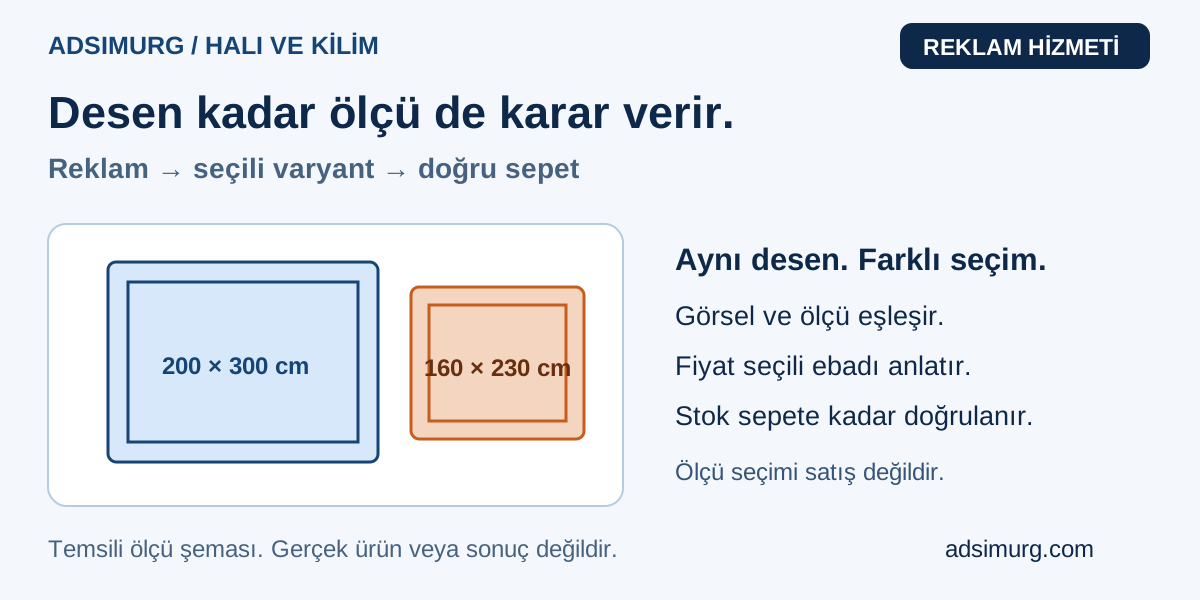
Imagine the same pattern offered in 160 × 230 cm and 200 × 300 cm. If the ad describes the larger size, the page should open that option with its actual price. The smaller size’s starting price should not appear to be the price of the larger rug. When the large size is unavailable, accurately explain any offered alternative. This example illustrates catalogue logic; it is not a customer campaign result or a statement of actual stock. The room layout does not represent a real customer’s home.
Measure selection without treating it as a sale
Product views, size changes, add-to-basket events and purchases are separate steps. GA4 ecommerce documentation describes the product-level item_variant field and purchase and refund events. Product identifiers, variant names and order records should be consistent. Preserve existing consent and privacy settings, and keep home or personal details out of measurement fields. Adapt the duplicate-record checks in the measurement test guide to the order journey as well.
Distinguish advertising issues from product and operational issues
Post-order questions and recorded return reasons can reveal gaps in product information. Size expectations, colour perception and delivery problems are different categories. Do not attribute an unexplained return to advertising or an incorrect customer choice. Assess spending and orders alongside the selected variant, stock period and reporting scope. Advertising reports and store revenue can have different boundaries. Establish the correct selection journey before proposing a budget change.
A starting checklist
- Show dimensions with units.
- Label illustrative room diagrams clearly.
- Match image, price, stock and variant.
- Test the selection from ad to basket on a phone.
- Separate selection from purchase events.
- Assess return reasons from verified records.
The Adsimurg approach
Adsimurg connects rug advertising with product imagery, variant selection and order measurement. Include a sample product page in your free Advertising and SEO audit request so we can review how size and price information carry from the ad to the basket.
Explore the relevant service scopes to put this plan into practice: Paid marketing, Landing pages & CRO, Visual design & video production.