The short answer
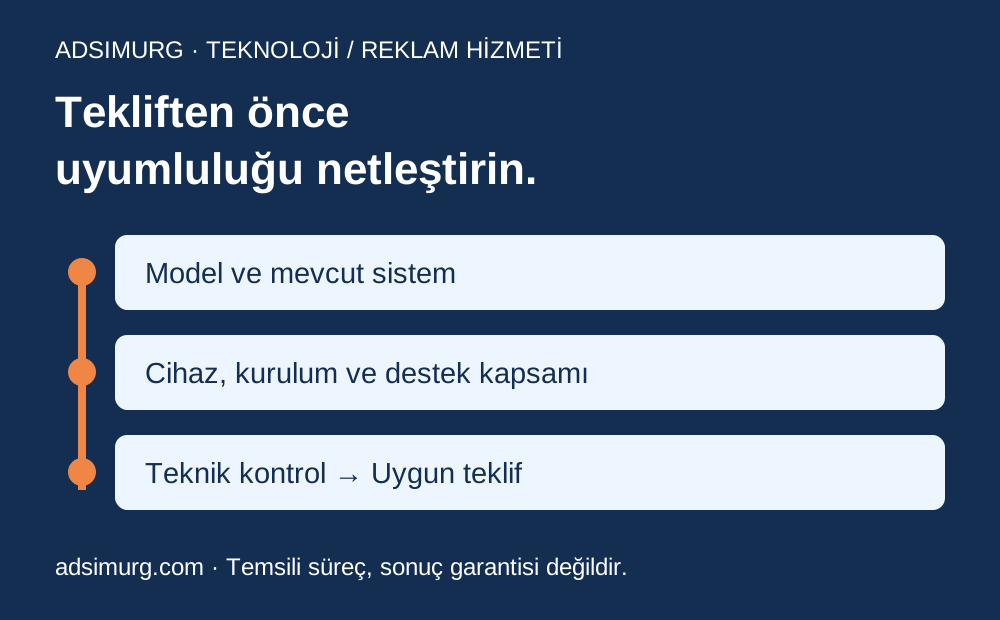
A model name and price may not answer a business buyer’s main question. Clarify the existing system, intended use and any installation expected beyond the device. Do not present unverified compatibility as a definite solution. Record qualified enquiries separately from completed sales.
| Check | Evidence needed | Next step if uncertain |
|---|---|---|
| Model compatibility | Relevant manufacturer documentation | Technical review |
| Delivery scope | Actual package contents | Clarify scope |
| Installation request | Available service and coverage | Assign an owner |
Translate product specifications into buying questions
A list of ports or capacities may not explain whether a device suits the buyer’s environment. Collect actual questions from sales conversations: will it work with existing software, who installs it and are extra parts needed? In the advertising service plan, prioritise questions you can answer with evidence. Do not guess compatibility. Mark the manufacturer’s exact model and version documentation as an item to check.
Illustrative scenario: network equipment for an office
Imagine a technology supplier selling network equipment to offices. Two businesses asking about the same model may have different connections, spaces and management requirements. One needs delivery only; the other expects installation. If the advertised package covers the device alone, avoid implying installation is included. This is a workflow illustration, not a product recommendation, brand case study or technical capacity claim.
Make scope and uncertainty visible on the page
Separate verified model details, box contents and separately purchased services on the product page. Link to the relevant manufacturer documentation. Describe delivery, returns and support using the business’s actual terms. If compatibility needs assessment, explain that technical review is the next step. Here, conversion improvement includes reducing unsuitable expectations before pushing more visitors into a form.
Ask only for information needed at the first decision
The type of need, public model details and expected delivery or installation scope can provide an initial starting point. Do not ask for network passwords, access keys, administrator accounts or detailed infrastructure data in a marketing form. Establish an appropriate secure process if deeper assessment becomes necessary. Do not mark a request as compatible before the responsible team completes the required check.
Use CRM stages to expose unconfirmed assumptions
In CRM follow-up, distinguish new enquiry, technical review pending, suitable quotation, out of scope and order. Record a concise reason for an unsuitable request, such as an unsupported model, unavailable installation or unclear need. A submitted form is not automatically a qualified customer, and a sent quote is not a sale. The lead qualification guide can help teams agree on shared definitions.
Identify which correction belongs in advertising
Repeated expectations of included installation warrant a message and page review. Suitable enquiries followed by slow quotations may point to an operational issue. Review qualified demand, technical review time and actual orders separately. Avoid firm performance conclusions from sparse data. In the next creative test, address one unanswered question and record the change date rather than promising sales.
A starting checklist
- Are the model and version verified?
- Are device, installation and support scopes separate?
- Is uncertain compatibility stated?
- Does the form avoid sensitive access details?
- Is a technical reviewer assigned?
- Are quotations separate from orders?
The Adsimurg approach
Adsimurg connects technology advertising with product information and the actual capacity of the quotation process. A free Advertising and SEO audit can review one product journey and identify messaging, page and follow-up priorities.
Explore the relevant service scopes to put this plan into practice: Paid marketing, Landing pages & CRO, CRM & sales operations.