The short answer
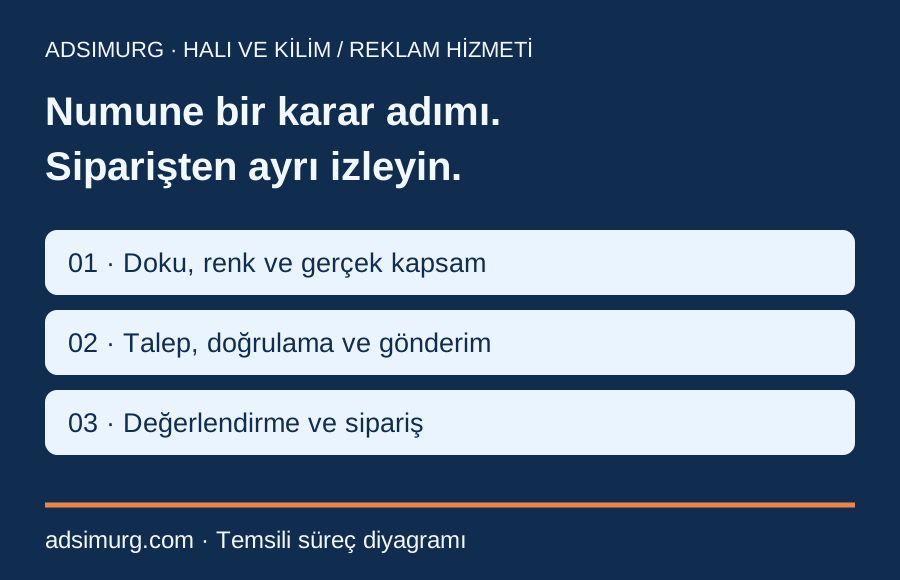
Define a sample request as a separate decision stage. Explain what is actually available and any verified charges or delivery conditions. Record requests, dispatches, evaluation and orders separately. Avoid judging advertising only by the cost of generating sample enquiries.
| Customer question | Content or action | Separate record |
|---|---|---|
| What is the texture? | Real close-ups and sample scope | Sample request |
| Will it suit my room? | Colour and available size information | Evaluation question |
| Can I order? | Verified stock and quotation | Order status |
Identify the decision the sample supports
A rug photograph may explain a pattern while texture or room suitability requires other information. If a real sample service exists, state what question it addresses. Is the sample a colour swatch or a texture piece, and which collections are included? Do not advertise a service that does not exist. An advertising service brief should treat sample evaluation and product purchase as separate objectives.
Build creative around accurate product information
Use authorised close-ups to show the surface, edges and texture. Treat a room scene and a product detail as distinct content. Explain that screen colours and physical products can differ rather than promising an exact match. Within creative production, do not present an illustrative room as a customer home. A sample image must not be confused with the contents of a full-size rug order.
Set expectations before the request
Make sample scope, available colours, applicable charges, delivery coverage and actual steps easy to find. Do not invent a delivery date. Keep sample dimensions separate from product sale sizes. The size and variant guide addresses the later product-selection step; this article focuses on reducing uncertainty before a purchase.
Illustrative example: a visitor choosing between two colours
Imagine a visitor comparing two colours in one collection. If the business genuinely offers both samples, record the selection and have an owner confirm availability and dispatch scope. Ask which information the customer needs to compare instead of pushing another product. This is not a real enquiry, conversion rate or sales result. Requesting a sample is not a commitment to buy.
Separate operational stages from sales
A CRM workflow can distinguish receipt, scope confirmation, dispatch, evaluation and order. Assign an owner and real evidence to each stage. Dispatch does not prove that the customer likes the product. Retain only necessary delivery information within the authorised process. Follow-up must respect the customer request and applicable communication permissions rather than becoming an automatic unrelated sales sequence.
Include sample costs in campaign evaluation
Review sample, packaging, shipping and team time using actual business records. A low enquiry cost alone does not establish profitable acquisition. Report a resulting order separately when a reliable connection exists; otherwise do not invent a rate. The lead qualification guide supports next-step decisions. Record changes to sample scope when comparing creative approaches.
A starting checklist
- Does the service actually exist?
- Are scope and product distinctions clear?
- Are images real and authorised?
- Are charges and delivery verified?
- Are request and dispatch separate?
- Is any order connection evidenced?
- Is follow-up ownership clear?
The Adsimurg approach
Adsimurg connects rug advertising with accurate product storytelling, sample decision journeys and CRM follow-up. A free Advertising and SEO audit can identify content and measurement priorities in the existing evaluation process.
Explore the relevant service scopes to put this plan into practice: Paid marketing, Visual design & video production, CRM & sales operations.